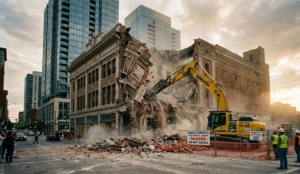
New construction is usually presented as the rational answer to housing needs. It appears clean, measurable, bankable, and future-oriented. By contrast, renovation is treated as sentimental, technically awkward, and financially uncertain. But this contrast is deeply misleading. What new construction often offers is not superior social, ecological, or even economic value. It offers legibility to a system built around standardisation: standard permits, standard insurance, standard finance, standard procurement, standard ownership structures. In that sense, the prestige of new construction is less an architectural truth than an administrative habit. Your own manuscript is right to place this chapter between demolition and financialization, because the preference for building anew is not just a design issue. It is a political economy of replacement.
The first myth is that new construction is cheaper. The accurate claim is narrower: new construction is often easier to price. A cleared site allows a developer to model costs with greater certainty; an existing building introduces unknowns, and the European Commission explicitly notes that cost remains a major hurdle to renovation while EU energy-renovation rates stay very low. But that does not prove that new buildings are inherently cheaper. It shows that the present system allocates risk in a way that penalizes reuse. Once demolition, waste handling, temporary displacement, the loss of usable structure, and longer-term urban impacts are counted, the comparison becomes case-specific rather than ideological. “Cheaper” depends on what is measured, over what time horizon, and for whose benefit. https://commission.europa.eu/system/files/2020-03/in_focus_energy_efficiency_in_buildings_en.pdf
This is why adaptive-reuse case studies matter. In the typologies where reuse fits, the numbers can be striking. Gensler’s assessment of more than 1,300 potential office-to-residential conversions found that suitable conversions could deliver housing at roughly 30% lower cost than new construction. A 2025 Pew/Gensler analysis likewise found that converting vacant offices in Los Angeles and Houston into small shared apartments could add hundreds of low-cost units per building, with public subsidy needs far below those required for conventional apartment conversion or ground-up new construction. That does not mean every office can or should become housing. It means the blanket claim that new construction is always the economical option is false. https://www.gensler.com/blog/what-we-learned-assessing-office-to-residential-conversions
The second myth is that new construction is greener. This claim collapses as soon as whole-life carbon enters the discussion. UNEP says buildings and construction account for over 34% of global energy demand and around 37% of energy- and process-related CO2 emissions. WorldGBC adds a crucial clarification: materials and construction alone account for 11% of global energy-related carbon emissions, and “upfront” carbon can make up half of the carbon footprint of new construction between now and 2050. This is the central environmental fact that demolition culture prefers not to see. A new efficient building may reduce operational energy, but it begins life with a carbon debt. When an existing structure is demolished, the embodied value of the old building is not replaced; it is discarded. https://www.unep.org/topics/energy/buildings
That is also why policy is beginning, belatedly, to move away from the fantasy that energy-efficient newness is enough. The revised Energy Performance of Buildings Directive explicitly incorporates life-cycle global warming potential into the European framework, with staged requirements for calculating and disclosing whole-life emissions for new buildings. Finland’s Building Act is moving in the same direction, tying regulation more directly to life-cycle impacts, longevity, adaptability, and material declarations at permit stage. In other words, the law itself is slowly admitting what the myth of new construction tried to conceal: a building is not just an object to heat and cool, but a stock of carbon, labour, and matter already invested. https://eur-lex.europa.eu/eli/dir/2024/1275/oj/eng
A third myth follows from the second: that “circular demolition” makes replacement good enough. Circular demolition is far better than blind waste, but it remains a second-best strategy. Construction and demolition waste accounts for more than a third of all waste generated in the EU. Finland’s RANTA project and the more recent Digipurku project show how materials and components can be catalogued, recovered, and recirculated more intelligently, and the Finnish Ministry of the Environment has supported demolition audits and better material reporting. These are important steps. But they do not change the hierarchy of value. Recovering doors, fixtures, and crushed concrete is preferable to landfill; preserving the building that contains them is better still. Circular demolition is damage control. It is not a substitute for adaptive reuse. https://environment.ec.europa.eu/topics/waste-and-recycling/construction-and-demolition-waste_en
This matters especially in Finland, where the attraction of newness is not only commercial but cultural. Recent Tampere University research argues that demolition has acquired a surprisingly positive status in Finland, even though renovation is the lower-carbon option and supports social and cultural sustainability. The same researchers explicitly note that decision-makers often know the ecological and financial advantages of renovation and still choose to build anew, and they stress that research does not support the stereotype that renovation is inherently too costly, too complex, or too risky. That diagnosis is important. It suggests that the triumph of new construction is not mainly about technical necessity. It is about a bias toward certainty, a distrust of irregularity, and a professional culture that treats the unknowns of reuse as grounds for erasure. https://www.tuni.fi/en/news/demolition-renovation-protecting-our-cultural-and-environmental-heritage
Once this becomes visible, the land-use argument changes as well. Housing shortages are real, but many crises are also crises of mismatch. Vacant or underused offices, empty schools, industrial shells, and obsolete municipal buildings coexist with rising housing demand. Adaptive reuse works within existing streets, utilities, and neighborhood memory instead of assuming that every unmet need requires a new footprint and a fresh round of extraction. The World Economic Forum’s adaptive-reuse model policy makes this point directly: reusing existing assets can reduce embodied and operational carbon while supporting housing supply, jobs, and community benefits. The question is therefore not whether new construction should disappear. It is whether it should continue to function as the unquestioned default. It should not. https://www3.weforum.org/docs/WEF_Adaptive_Reuse_Assets_Model_Policy_2024.pdf
Lina Bo Bardi’s SESC Pompeia transformed an old factory into a public complex of culture, sport, and everyday life by reusing and enhancing what was already there, adding only what was necessary. Instituto Bardi describes the project in exactly those terms: Bo Bardi repurposed, renovated, and refurbished the existing factory buildings instead of clearing the site and starting over. That matters because SESC Pompeia is not simply a heritage example. It is a design argument. It shows that the opposite of demolition is not museumification. It is intelligent continuation. The same lesson runs through office conversions, through minimalistic renovation, and through the GC method itself: build new when necessary, but begin with what exists. https://institutobardi.org.br/en/revista/lina-bo-bardis-sesc-chair/
So the myth of new construction should be named accurately. New construction is not inherently cheaper, greener, or more rational. It is often simply more compatible with institutions built around short time horizons, standardized risk, and tradable assets. Renovation asks harder questions: what can be kept, adapted, shared, repaired, or reprogrammed? Those questions are slower. They are less convenient for finance. But they are better questions for a society that claims to care about climate, affordability, heritage, and democracy. The right default is therefore clear: demolition only when necessary, circular demolition when demolition is unavoidable, adaptive reuse wherever possible, and new construction only when a serious comparison has shown that continuation is no longer defensible. Your later chapter already has the right phrase for this: new construction only when necessary. (https://ym.fi/-/hanketuloksia-rakennusten-purkamiselle-on-vaihtoehtoja-kun-ne-vain-selvitetaan?languageId=en_US)
Pedro Aibéo
Kathmandu, 19.03.2026