Buildings rarely disappear with drama. They do not collapse in heroic explosions or cinematic implosions. Most simply fade. Maintenance is postponed. A leaking roof is patched for the third time. A ventilation system becomes “temporary.” Consultants begin writing reports. Engineers circulate cautious recommendations. Eventually someone declares renovation “uneconomical.” A decision is taken. A crane arrives.
By evening, a building that stood for decades, sometimes a century, has become a mound of sorted concrete.
In 2021, for example, the city of Vantaa demolished the Koivukylä school complex built in the 1970s. The reinforced concrete structure itself remained structurally viable; the demolition was justified primarily through indoor-air concerns and the estimated cost of renovation. Within weeks the building that had served generations of students was reduced to piles of crushed concrete waiting for transport.
This quiet ritual of disappearance has become routine in much of the developed world. In Finland, the pattern is particularly striking. Thousands of buildings are demolished each year, not because they have structurally failed, but because renovation is deemed administratively inconvenient or economically uncertain. Schools from the welfare-state era, municipal buildings from the 1960s and 1970s, industrial structures, apartment blocks, many remain structurally viable yet are removed to make space for new construction.
Demolition has become the default response to aging architecture.
This pattern is visible across the country. Municipalities routinely face the same decision: invest in complex renovations of aging public buildings or clear the site and construct a replacement that fits contemporary technical standards. Increasingly, the latter option prevails.
This pattern is often justified through technical language. Buildings are described as energy inefficient. Plumbing systems are outdated. Insulation does not meet current standards. Indoor air quality reports raise concerns about mold risk. The conclusion appears self-evident: renovation would cost too much, therefore demolition is inevitable.
But inevitability is rarely neutral. It is produced.
In practice, many buildings heading toward demolition are not collapsing structures but victims of what might be called administrative exhaustion. Maintenance has been deferred for years until decay accumulates to the point where renovation appears financially irrational. The building does not die suddenly; it moves slowly toward what could be described as a kind of silent extinction. Neglect becomes the precondition for demolition.
A typical example is the small-town school building that receives temporary roof repairs for years while renovation decisions are postponed. By the time a comprehensive technical assessment is finally commissioned, the accumulated maintenance backlog makes demolition appear financially unavoidable.
Once the process reaches that stage, the demolition argument becomes almost impossible to challenge.
The Administrative Logic of Demolition
The deeper problem is not primarily architectural. It is institutional.
Renovation requires interpretation. Each building is unique. Hidden conditions must be investigated. Structural elements must be evaluated. Technical systems must be upgraded in ways that adapt to the existing structure rather than replacing it entirely. Engineers, planners, and users must negotiate solutions that balance safety, cost, and preservation.
New construction, by contrast, fits comfortably within bureaucratic frameworks. Standardized regulations, insurance templates, and procurement systems are designed for predictable, repeatable processes. A cleared site simplifies everything.
Within many public administrations, this creates what could be described as a frozen middle of decision-making. At the political level, sustainability and circular economy are often celebrated as national goals. At the operational level, however, mid-level administrative structures remain bound by procedures that discourage experimentation. Officials rarely possess the authority to reinterpret regulations creatively, yet they retain the power to halt projects that fall outside standard practice.
Renovation proposals therefore encounter a structural barrier. They require flexibility within systems designed to eliminate it.
Municipal project managers sometimes describe this dilemma candidly: constructing a new building follows a clear regulatory pathway, while renovating an existing one often triggers dozens of individual compliance questions, from stair geometry to ventilation standards, each requiring separate approvals.
Insurance frameworks reinforce this rigidity. Reusing building components, even when technically safe, can become impossible under liability rules. A plumber may refuse to reinstall a perfectly functional water heater, not because it is unsafe, but because insurance policies prohibit the reuse of certified equipment once removed. Contractors and consultants, understandably unwilling to assume personal liability, default to the safest administrative option: new materials, new construction, new warranties.
Even minor components illustrate the problem. A perfectly functional heating unit removed during renovation may be legally impossible to reinstall because certification rules treat reused equipment as uninsured. The technical condition of the component becomes secondary to the administrative framework governing its reuse.
The cumulative effect is subtle but powerful. Renovation becomes bureaucratically difficult. Demolition becomes administratively simple.
The Carbon Paradox
This preference for demolition sits uneasily with environmental reality.
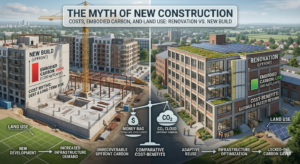
The construction sector is among the largest contributors to global carbon emissions. A significant portion of these emissions arises not from the operation of buildings but from the production of materials such as concrete, steel, glass, and insulation. When a building is demolished, the embodied carbon invested in its structure is effectively discarded.
In theory, energy-efficient new buildings promise lower operational emissions. In practice, the environmental cost of producing their materials often offsets those savings for decades.
A structurally sound concrete frame can remain viable for many generations. To demolish it because mechanical systems or insulation require replacement is analogous to scrapping a ship because its navigation equipment has become outdated. The structure remains capable of service; only its systems require modernization.
Renovation preserves embodied carbon. Demolition erases it.
A reinforced concrete frame built in the 1960s may remain structurally sound for a century or more. Demolishing such a structure after sixty years effectively discards decades of potential service life, and the carbon emissions invested in producing the original concrete.
Yet the prevailing logic of development frequently ignores this distinction. Environmental assessment frameworks often emphasize operational energy performance while underestimating the emissions associated with material production and construction.
The result is a paradox: demolition and rebuilding can be presented as a sustainability strategy.
Circular Demolition: Mitigating the Inevitable
Finland has not ignored the environmental implications of demolition. Several initiatives have emerged to reduce waste and recover materials from buildings that must be dismantled.
Among the most notable are projects such as RANTA and Digipurku, which explore methods of “circular demolition.” Instead of treating demolition debris as waste, these initiatives attempt to recover and reuse materials before buildings are dismantled.
In practice this involves cataloguing reusable components—windows, doors, structural elements, fixtures—and redirecting them into secondary markets. Materials that cannot be reused directly may be repurposed in other ways: crushed concrete can become road base or noise barriers, while salvaged architectural elements can be auctioned to builders and designers.
In several pilot projects, salvaged doors, windows, and fixtures have even been sold through public auctions before demolition begins. The practice reflects a growing awareness that buildings contain valuable materials—though the building itself is still lost.
Digital tools play an increasing role in this process. By mapping buildings through Building Information Modeling (BIM), demolition teams can identify reusable materials in advance and organize logistics to minimize transportation emissions. The building becomes a temporary material bank rather than a pile of waste.
These initiatives represent an important step toward circular construction practices.
But they do not resolve the deeper question.
Circular demolition may reduce waste, yet it still begins from the assumption that demolition itself is necessary. The environmental gains of material recovery remain limited compared to the ecological value of preserving an existing structure.
The most sustainable building is often the one that already exists.
Economic Incentives and the Bias Toward New Construction
Beyond administrative logic and environmental considerations lies another powerful force: economic structure.
Renovation projects tend to distribute labor across smaller contractors, craftspeople, and local specialists. Work progresses gradually, often in phases, and requires continuous adaptation to the conditions of the building.
Large-scale new construction, by contrast, aligns neatly with the financial logic of contemporary development. It enables standardized construction processes, large investment packages, and predictable project timelines. Financial institutions and developers operate comfortably within these frameworks.
This does not necessarily imply malice or conspiracy. It reflects a structural alignment between economic incentives and construction practices. New buildings generate larger capital flows, clearer financing structures, and more easily quantifiable returns.
Renovation, particularly participatory renovation involving communities, resists such simplification.
For a developer evaluating a site, the calculation is straightforward: if a five-storey building can legally be replaced by an eight-storey one, demolition immediately transforms into an opportunity to increase floor area and financial return.
Consequently, demolition and new construction frequently appear as the economically “rational” path—even when environmental or social considerations suggest otherwise.
The Disappearance of Civic Architecture
The consequences extend beyond carbon emissions and financial models.
Buildings are repositories of social memory. Schools, municipal halls, factories, and apartment buildings accumulate stories over decades of use. Their walls record the routines of daily life: classrooms filled with children, community meetings, local celebrations, quiet moments of ordinary existence.
Former students often describe a strange experience when such buildings disappear: the physical place that anchored childhood memories vanishes almost overnight, leaving only photographs and recollections behind.
When such buildings disappear, these layers of memory vanish with them.
Post-war Finland invested heavily in civic architecture. Hundreds of schools and public buildings were constructed across the country as expressions of social commitment and national development. These structures were designed not only as functional spaces but as symbols of a society investing in its future.
Today many of these same buildings face demolition.
Their disappearance reflects more than technical obsolescence. It signals a shift in how societies value continuity, heritage, and the role of architecture in civic life.
A Different Possibility
Against this backdrop, alternative approaches to renovation begin to emerge.
Instead of treating aging buildings as liabilities, they can be understood as opportunities—structures capable of supporting new forms of habitation and community life. Empty schools, abandoned factories, and disused municipal buildings possess spatial qualities that are difficult to replicate in contemporary construction: generous volumes, durable structures, and connections to local history.
Projects based on adaptive reuse demonstrate that such buildings can become living laboratories for new forms of architecture.
This is where the idea of Gamified Cohousing begins to enter the discussion. Rather than demolishing unused buildings, the model explores how communities can gradually reclaim and transform them through participatory renovation. Minimal interventions, modular systems, and shared governance structures allow residents to adapt existing architecture to contemporary needs.
The objective is not nostalgic preservation. It is pragmatic reinvention.
Where demolition clears the ground for standardized development, renovation preserves complexity. It allows buildings to evolve rather than disappear.
In this sense, the question is not whether demolition can be made more efficient or more circular.
The more fundamental question is why demolition has become the default response to architectural aging in the first place.
Until that assumption is challenged, the cranes will continue to arrive.
And the quiet extinction of buildings, and the histories they contain, will continue with them.
Pedro Aibéo
17.03.2026