The contemporary housing crisis is often framed as a shortage problem. Not enough homes, not enough speed, not enough efficiency. This framing is comforting because it suggests a technical fix: build more, build faster, build higher. Yet this diagnosis avoids a more unsettling truth. In many countries, Finland included, we have not failed to build housing. We have succeeded in regulating it to the point where ordinary citizens are no longer allowed to meaningfully participate in its creation.
Housing did not become inaccessible overnight. It was regulated, insured, zoned, certified, financialized, and professionalized out of reach. What was once a social and civic activity, building shelter, adapting buildings, living collectively, has been converted into a highly controlled industrial process accessible only to a narrow coalition of developers, consultants, insurers, and financial institutions. Architecture, once a shared cultural act, has become a gated profession serving a gated market.
This chapter argues that the housing crisis is not merely economic or technical. It is democratic.
Overregulation as a Design Strategy
Regulation is not inherently the enemy. Fire safety, structural integrity, hygiene, and accessibility matter. The problem emerges when regulation ceases to function as a minimum safeguard and instead becomes a maximum boundary of possibility.
In Finland, building legislation has evolved into a dense web of overlapping classifications: building use categories, fire classes, height limits, occupancy thresholds, parking norms, acoustic requirements, energy performance calculations, insurance prerequisites. Each regulation, taken alone, appears reasonable. Together, they form an exclusionary system that quietly disqualifies small actors, cooperatives, and citizen-led initiatives before they even begin.
A single change of use, from school to housing, from office to mixed use, can trigger a cascade of requirements that make renovation financially irrational. Not unsafe. Irrational. The system does not say you may not build. It says you may build only if you already have capital, consultants, and institutional backing.
This is not accidental. Regulatory complexity functions as a filter. It favours scale, repetition, and risk-averse actors. It punishes adaptation, reuse, and experimentation. In effect, regulation has become a design strategy, one that designs people out of the process.
Insurance: The Invisible Legislator
If building codes are the visible architecture of exclusion, insurance is the invisible one.
In theory, insurers assess risk. In practice, they enforce conformity. Anything that deviates from standardized building typologies, shared facilities, incremental renovation, hybrid uses, participatory construction, becomes either uninsurable or prohibitively expensive. The result is a silent veto power over innovation, exercised not by elected officials but by actuarial models optimized for predictability, not social value.
In Finland, insurance requirements often exceed legal requirements. A project may be technically permissible under planning law yet rendered impossible because no insurer is willing to underwrite it. This shifts power away from democratic institutions toward private risk managers whose incentives are fundamentally misaligned with housing affordability or community resilience.
When insurance logic replaces political judgment, architecture stops being a civic act and becomes a financial product.
Zoning and the Freezing of the City
Zoning was introduced as a tool to protect citizens from industrial harm and speculative chaos. Over time, it has evolved into a system that freezes cities into rigid functional silos: residential here, work there, care somewhere else, culture somewhere else again.
This rigidity is especially paradoxical in a post-industrial context. Across Europe, and acutely in Finland, cities are filled with underused offices, empty schools, abandoned retail spaces, and oversized infrastructure from another economic era. At the same time, housing shortages are framed as justification for demolition and new construction rather than adaptive reuse.
The city, in effect, is not allowed to learn.
Office-to-residential conversions illustrate this contradiction. Technically feasible. Socially desirable. Environmentally responsible. Yet frequently blocked by zoning interpretations, parking requirements, daylight regulations calibrated for new buildings, or fire classifications that ignore the realities of existing structures. The result is a city that destroys what it already has in order to produce what regulation already understands.
When Demolition Becomes the Default
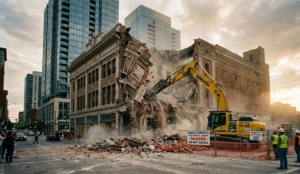
Finland has quietly become one of Europe’s demolition leaders, not because its buildings are uniquely unsafe or obsolete, but because demolition has been normalized as the most administratively convenient option.
It is often easier to demolish a structurally sound building than to negotiate its reuse. Easier to start from zero than to engage with complexity. Easier to erase history than to manage it.
This logic is presented as pragmatism. In reality, it is institutional laziness reinforced by economic incentives. New construction aligns neatly with standardized financing models, insurance frameworks, procurement processes, and political timelines. Renovation, especially participatory renovation, does not.
Demolition is not just a material act. It is a political one. It severs continuity, dissolves memory, and eliminates the possibility of incremental, community-driven transformation. A demolished building cannot be democratically reclaimed.
The Myth of New Construction
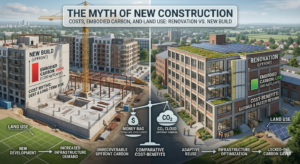
New construction is routinely justified through three myths: it is cheaper, more sustainable, and more efficient.
None of these claims withstand serious scrutiny.
Renovation typically outperforms new construction on embodied carbon. Reuse preserves energy already spent. It minimizes waste. It avoids the environmental cost of extraction, transport, and industrial processing. From a land-use perspective, renovation also respects existing urban fabric rather than extending sprawl.
Cost comparisons are more nuanced but equally revealing. While upfront costs of renovation can appear higher due to regulatory triggers, lifecycle costs often favour reuse, especially when community participation reduces operational expenses and management overhead.
What new construction truly offers is not efficiency, but predictability. Predictable margins. Predictable risk profiles. Predictable ownership structures. In short, predictability for capital, not for communities.
From Community to Commodity
Perhaps the most profound shift in housing over the past century has been its transformation from a social good into a financial asset.
Housing is no longer primarily designed to be lived in. It is designed to be traded.
This shift has consequences that extend far beyond affordability. It erodes communal living traditions, marginalizes non-nuclear households, and delegitimizes shared ownership models. Forms of living that once relied on mutual responsibility, cooperatives, collectives, extended households, are treated as anomalies rather than legitimate housing types.
In Finland, communal living has deep historical roots, from rural shared farms to worker housing to student cooperatives. Yet contemporary housing policy treats these traditions as deviations from the norm rather than as resources for resilience.
When housing becomes a commodity, citizens become consumers. And consumers do not build cities. They merely occupy them.
A System That Cannot Imagine Its Users
The cumulative effect of overregulation, insurance dominance, zoning rigidity, demolition bias, and financialization is a system that no longer imagines its users as capable actors.
Citizens are assumed to be uninformed. Communities are assumed to be risky. Participation is treated as a liability rather than an asset. Architecture becomes something done to people, not with them.
The housing crisis is not simply about supply. It is about trust. A system that does not trust its citizens will inevitably design them out. And a city built without its citizens will, sooner or later, fail them.
The Orthogonal City
It is no coincidence that contemporary regulation prefers right angles.
Zoning separates functions into clean rectangles. Fire compartments divide buildings into measurable units. Insurance categories classify risk into discrete boxes. Parking norms quantify life in square meters per vehicle. Use classes fix activity into rigid grids. Even participation is formalized into predefined consultation slots.
The modern city is governed as if it were a technical drawing.
Orthogonality promises clarity. It promises legibility. It promises control. In an orthogonal system, everything aligns, everything stacks, everything can be calculated. Risk flows vertically. Responsibility moves horizontally. Deviations are immediately visible because they refuse to align with the grid.
But life is not orthogonal.
Buildings age irregularly. Families reorganize themselves. Work migrates into living rooms. Care moves into former offices. Schools become housing. Housing becomes workshop. Communities overlap. Uses bleed. Adaptation rarely respects a 90-degree angle.
The problem is not that pipes run vertically and horizontally. Gravity demands that. The problem is that governance has adopted the same geometry as a moral principle.
When regulation becomes orthogonal, anything diagonal appears dangerous. Mixed uses seem unstable. Shared facilities look ambiguous. Incremental renovation feels unfinished. Participation appears disorderly. Complexity is mistaken for risk.
And so the system defaults to what aligns neatly: demolition, replacement, repetition. A new grid over an old one. Clean lines over layered histories. Predictable typologies over adaptive reuse.
Orthogonality, in this sense, is not a construction detail. It is a worldview. A democratic city must tolerate diagonals. It must allow uses to blur, roles to overlap, responsibilities to be shared. It must accept that adaptation produces irregularity. That participation produces friction. That trust produces geometry that cannot always be pre-calculated.
The question, then, is not whether plumbing must be orthogonal. The question is whether governance must be. If housing has become impossible for citizens, it is not because gravity changed. It is because the grid hardened.
To redesign housing, we may need to bend the lines.
Pedro Aibéo
Gamified Cohousing Oy
Kathmandu 11.02.2026